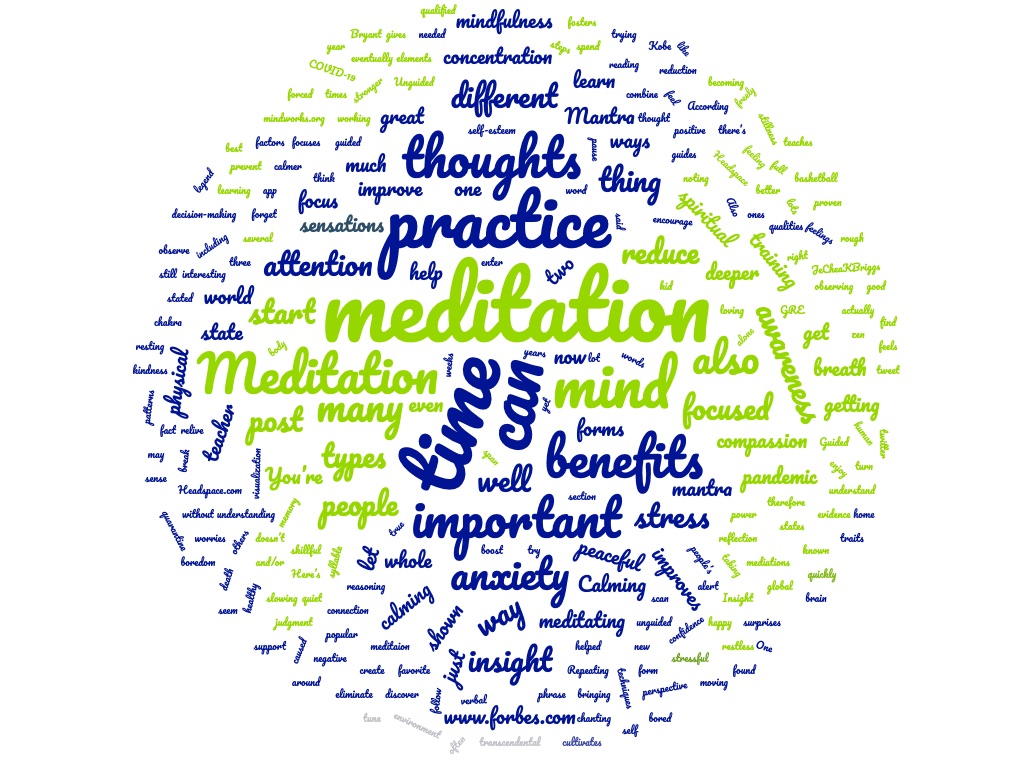
The year 2020 has proven itself to be full of many surprises, to the death of basketball legend Kobe Bryant to the global pandemic known as COVID-19. This pandemic has caused much the world to pause and forced us all to self-quarantine. For some people, this has been a very rough time because it prevents us from moving around freely. With everyone at home, many people are quickly becoming bored and restless. During this time, do not let boredom get the best of you. Use this time to get in tune with yourself and learn to practice stillness.
What is Meditation?
Meditation is about training awareness and getting a healthy sense of perspective. You’re not trying to turn off your thoughts or feelings. You’re learning to observe them without judgment. And eventually, you may start to better understand them as well. Meditation is the practice of slowing your thoughts down and having a still mind.
Why is Meditation important?
Meditation is vital because, in stressful times, it can help reduce anxiety, and it gives the mind time to rest. It is essential because it eliminates negative thoughts, worries, and all factors that can prevent us from feeling happy. According to www.forbes.com, “A lot of people start meditating for its benefits in stress reduction, and there’s lots of good evidence to support this rationale. There’s a whole newer sub-genre of meditation, mentioned earlier, called Mindfulness-Based Stress Reduction (MBSR), developed by Jon Kabat-Zinn at the University of Massachusetts’ Center for Mindfulness (now available all over the country), that aims to reduce a person’s stress level, physically and mentally. Studies have shown its benefits in reducing anxiety, even years after the initial 8-week course. Research has also shown that mindfulness meditation, in contrast to attending to the breath only, can reduce anxiety – and that these changes seem to be mediated through the brain regions associated with those self-referential (“me-centered”) thoughts.”
Meditation is also essential because it can improve concentration and attention span. Meditating teaches us mindfulness and promotes traits like focus and decision-making. www.forbes.com also reported, “Having problems concentrating isn’t just a kid thing – it affects millions of grown-ups as well, with an ADD diagnosis or not. Interestingly but not surprisingly, one of the central benefits of meditation is that it improves attention and concentration: One recent study found that just a couple of weeks of meditation training helped people’s focus and memory during the verbal reasoning section of the GRE.” Meditation has many benefits and can be a great way to relieve stress and anxiety during this time.
Types of Meditation
There are several different types of meditation such as guided and unguided meditation. Guided meditation is when a teacher guides you through various steps. Unguided meditation is when you practice alone. Some other types of meditation are reflection, resting awareness, skillful compassion, loving-kindness, visualization, noting, body scan, focused attention, zen meditation, mantra meditation, transcendental meditation, and chakra meditation. My three favorite types of meditation are mantra, calming, and insight meditation.
Mantra meditation is when your mind is focused on the words that are being said and getting power from them. Repeating a syllable, word, or phrase can encourage a boost in self-esteem. It can also help you enter an even deeper state of meditation. A post by mindworks.org states, “Those who enjoy chanting meditation often discover that their practice cultivates a peaceful, yet alert, state of mind. As a spiritual practice it fosters deeper awareness and a stronger connection to positive human qualities such as compassion and confidence. As with any true spiritual practice, it is important to find a qualified teacher.” Mantra meditation is an excellent form of meditation because it improves the way you feel about yourself and others.
Calming and Insight mediations are two other popular forms of meditation. Calming meditation is to create a quiet and peaceful environment while you practice, while Insight meditation focuses on the breath and physical sensations. As the mind feels calmer and more focused, we learn to start observing our physical sensations as well as our thought patterns, therefore bringing a whole new understanding to why we think the way we do.
A post by Headspace.com stated, “Here’s the interesting thing about meditation: it doesn’t have to be one or the other, calming or Insight. In fact, many meditation techniques — including the ones in the Headspace app — actually combine elements of both.”
There are so many different ways and benefits to meditating. While we have this time to ourselves, we must spend time working on ways to improve. The world is taking a much-needed break right now, so why not let your mind do the same thing. After reading this post, try two forms of meditation and tweet me your thoughts. Also, don’t forget to follow me on twitter @JeCheaKBriggs





 Soul Food & Chea Butter